
Botanical Supplements
What’s in the bottle matters more than where you bought it.
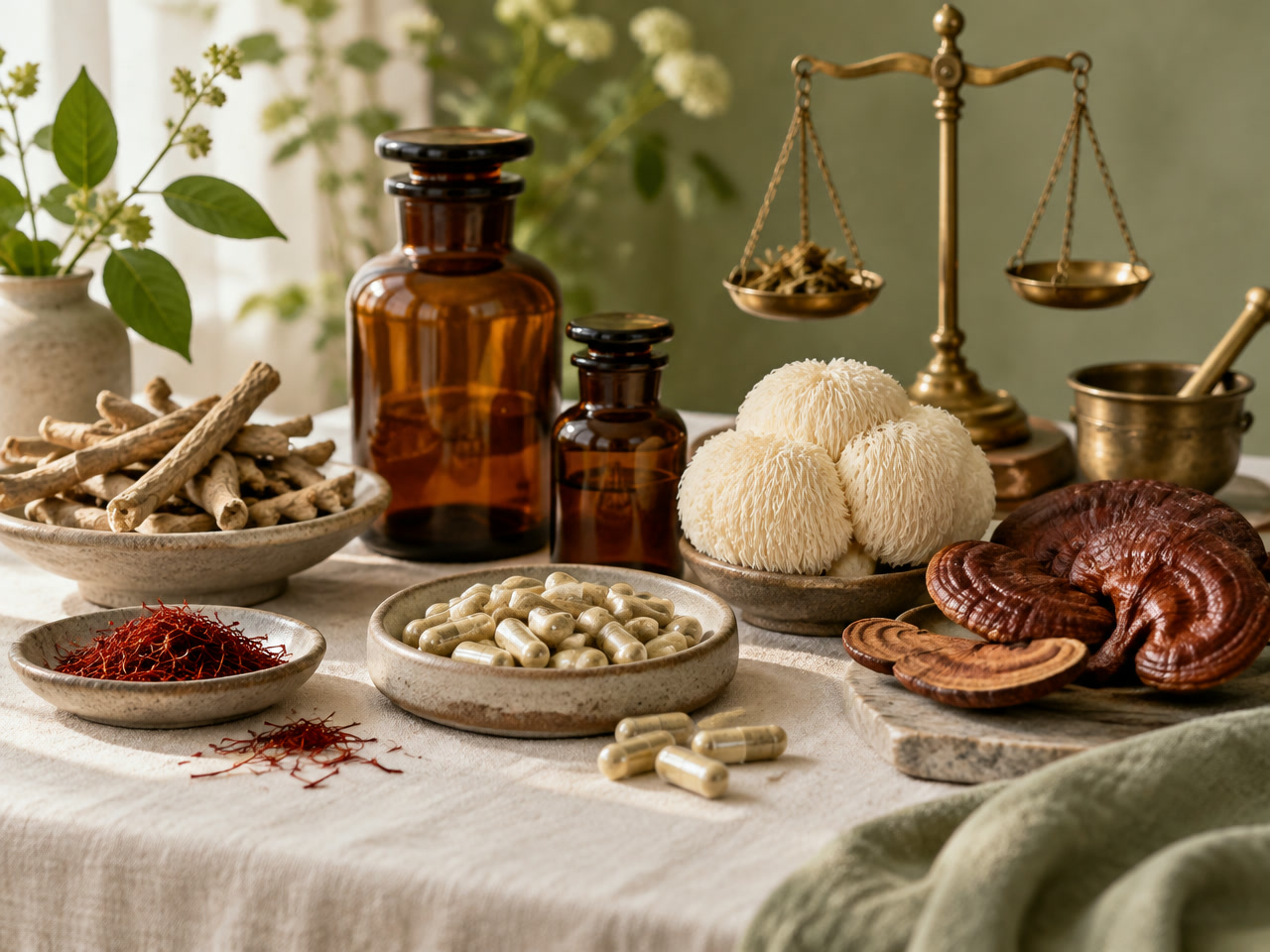
A saffron gummy for mood. Lion’s mane in your morning coffee. Ashwagandha when you’re tired but still can’t switch off. Some of these ingredients have interesting human research behind them. Others have a better marketing team than clinical record.
This is just a small snapshot of what’s out there, from concentrated plant extracts to non-psychedelic mushrooms. If you’re looking for support with stress, restless sleep, low mood or low energy, you can always research what botanical or natural options are available, and we hope it opens up a few possibilities you hadn’t considered.
Start with what you’d like help with, then ask what researchers actually tested. A study on one extract can tell you a lot about that extract and very little about the blend sitting next to it.
Stress, sleep, mood & energy
01| What you’ll see on the shelf | Why people reach for it | What the research says |
|---|---|---|
| What you’ll see on the shelfAshwagandha | Why people reach for itStress and restless sleep | What the research saysSeveral short trials found improvements in perceived stress or sleep with specific extracts. Long-term safety is unclear. It can affect thyroid function, and Australia’s TGA warns of a very rare risk of liver injury. |
| What you’ll see on the shelfSaffron gummies, capsules and extracts | Why people reach for itLow mood, stress and sleep | What the research saysIn a 12-week trial of adults with low mood, 72% taking a specific saffron extract had a meaningful improvement on a depression symptom scale, compared with 54% taking placebo. A separate four-week trial found modest improvements in insomnia symptoms with another extract. If you’re looking at a gummy, check which extract it contains and how much you get per serving. |
| What you’ll see on the shelfAsian ginseng (Panax ginseng) | Why people reach for itFatigue and energy | What the research saysResearch suggests a possible small benefit for general fatigue, although results vary. Look for the species on the label. The findings apply to the type of ginseng studied. |
| What you’ll see on the shelfLavender oil capsules | Why people reach for itAnxiety | What the research saysA placebo-controlled trial found that a specific oral lavender oil preparation reduced anxiety symptoms. These were capsules made to be swallowed. Keep the lavender oil you use in a diffuser for scent. |
Mushrooms for the mind
02Functional mushrooms are one of the most exciting corners of this space, and the research is growing. Most trials so far are small and short, so think of these as promising leads rather than proven answers.
Lion’s mane is the one to explore if you’re curious about cognition and mood. A small trial in older adults with mild cognitive impairment found better scores on a cognitive test during supplementation. Scores declined after people stopped taking it. That’s an interesting signal from a specific group. We still need better evidence on whether it helps with everyday focus or brain fog.
It’s also being studied for mood and stress. In one small trial, women who ate lion’s mane every day for four weeks reported lower depression and anxiety scores. In another, healthy young adults completed a thinking task faster an hour after a single dose, and showed a trend towards less stress after four weeks.
| Mushroom | What people look for | Where the evidence sits |
|---|---|---|
| MushroomReishi | What people look forStress, rest and recovery | Where the evidence sitsOne older placebo-controlled trial reported improvements in fatigue and wellbeing with a specific extract in people with persistent fatigue symptoms. Newer trials are looking at stress and anxiety. In a 2026 trial, young women with stress or anxiety who took a lion’s mane and reishi blend for four weeks reported lower anxiety than those taking lion’s mane alone, and a 2024 trial in university students reported less anxiety and better wellbeing with daily reishi. It’s still unclear whether the reishi powders sold for sleep help people sleep better. |
| MushroomCordyceps | What people look forEnergy and stamina | Where the evidence sitsA small trial in older adults found improvement in some exercise measures with a particular cultured preparation. The study leaves plenty of room for questions about other products and younger or more active people. |
| MushroomMaitake | What people look forMemory and thinking as we age | Where the evidence sitsAlso a delicious mushroom to cook with. In a 2026 trial, healthy adults over 60 who ate bread containing one strain of maitake for 18 weeks scored better on a memory and thinking test. A second strain made no difference, and the study was funded by a maitake grower, so it needs independent confirmation. |
How to source a product you can trust
03A chemist can be a good place to ask about interactions. A specialist supplier may be able to tell you more about where an ingredient was grown and how it was processed. In either case, ask to see what backs up the label.
- Look for the exact ingredient and amount. The label should tell you the species, the plant or mushroom part used, the extract if applicable, and the amount per serving. For mushrooms, look for whether it contains the fruiting body, mycelium or both. For gummies, check the serving size and the amount of the actual extract. A proprietary blend makes it hard to tell how much of each ingredient you’re getting.
- Ask for a batch test. A certificate of analysis should match the lot number on your pack. Look for independent testing that verifies identity and checks relevant contaminants such as heavy metals and microbes. If the label advertises a beta-glucan content, ask whether the batch was tested for it. Batch testing tells you about what’s in the product. Human studies tell you what it might do.
- Know what the Australian label means. For a product sold as a listed medicine, AUST L means the sponsor must hold evidence for the claims, but the TGA generally hasn’t assessed that evidence before sale. AUST L(A) means the TGA has assessed evidence for the product’s specified claims. Some powders and drinks are sold as foods and sit under different rules.
- Match the product to the research. If a brand says clinically studied, ask for the paper. Did it test the same extract, at a comparable amount, in people with the concern you’re looking to address? Who funded it, and has anyone else replicated the result? Those questions are useful whether the product came from a chemist, a practitioner or an Instagram ad.
Before you start
04Pick one thing you’d like to change and one product to evaluate. If it’s sleep, decide what would count as better for you. Falling asleep sooner? Fewer wake-ups? Feeling more rested in the morning? That gives you something concrete to review before buying another bottle.
If you take regular medicines, are pregnant or breastfeeding, or have a liver or thyroid condition, show the exact label to a pharmacist or treating clinician before starting. This matters especially with ashwagandha. The TGA advises people with current or previous liver problems to avoid medicinal ashwagandha products.
You’ve read about it. Now what can you actually do?
You don’t need to have the perfect plan. Choose the next step that feels most useful for where you are right now.
Always speak with a qualified health professional before starting something new. If you are struggling right now, find immediate support.
Want to keep exploring?
Recommended articles, books, podcasts and lived experiences related to this topic.
Explore the LibraryRelated Tools
This is educational information. It is not a recommendation that this approach is right for you. Always speak with a qualified health professional.
