The Rewire
We can rewire our brains, habits, beliefs and behaviours which in turn means we can change our lives
It takes time but your brain can learn new ways to respond, even when the old ones feel automatic.

“If you can change your mind, you can change your life.”
Jack Canfield
You can understand a pattern perfectly and still find yourself repeating it. You know you want to speak up, but you go quiet. You mean to put your phone down, then realise you’ve been scrolling for half an hour. You can know something is bad for you but you continue to do it. Becoming aware and understanding the pattern is the beginning. The next step is pausing, practising a response, and trying to choose differently in that moment, so the new choice becomes a new habit or behaviour.
3 ways to explore

How Your Brain Develops
Explore how the brain builds and refines connections from childhood into adulthood.

Six ways to practise a new pattern
Begin with awareness and explore six practical ways to respond differently.

Tools & Therapies for change
Explore therapies, coaching, body-based practices and brain technologies that may support change.
What does it mean to rewire your brain?
Your brain keeps adapting throughout adulthood. As you learn, connections between brain cells can strengthen or weaken, new connections can form, and networks can change how they work together. This capacity to adapt is called neuroplasticity.
Think about learning to drive. At first, checking the mirrors and judging distance take deliberate attention. With practice and feedback, those actions become easier to coordinate. A similar principle applies when you’re learning to pause before answering or to speak up when you’d usually stay quiet. Start somewhere the stakes are low, then practise in the situations where you want to use the skill.
How a pattern becomes familiar
The brain’s capacity to learn can help you build skills and can reinforce patterns you’d like to change. If avoiding a conversation brings relief, you may be more inclined to avoid the next one. If scrolling helps you switch off after a difficult day, feeling overwhelmed can become a cue to pick up your phone. If feelings become overwhelming and numbing them becomes a short-term solution that can lead to long-term concerns.
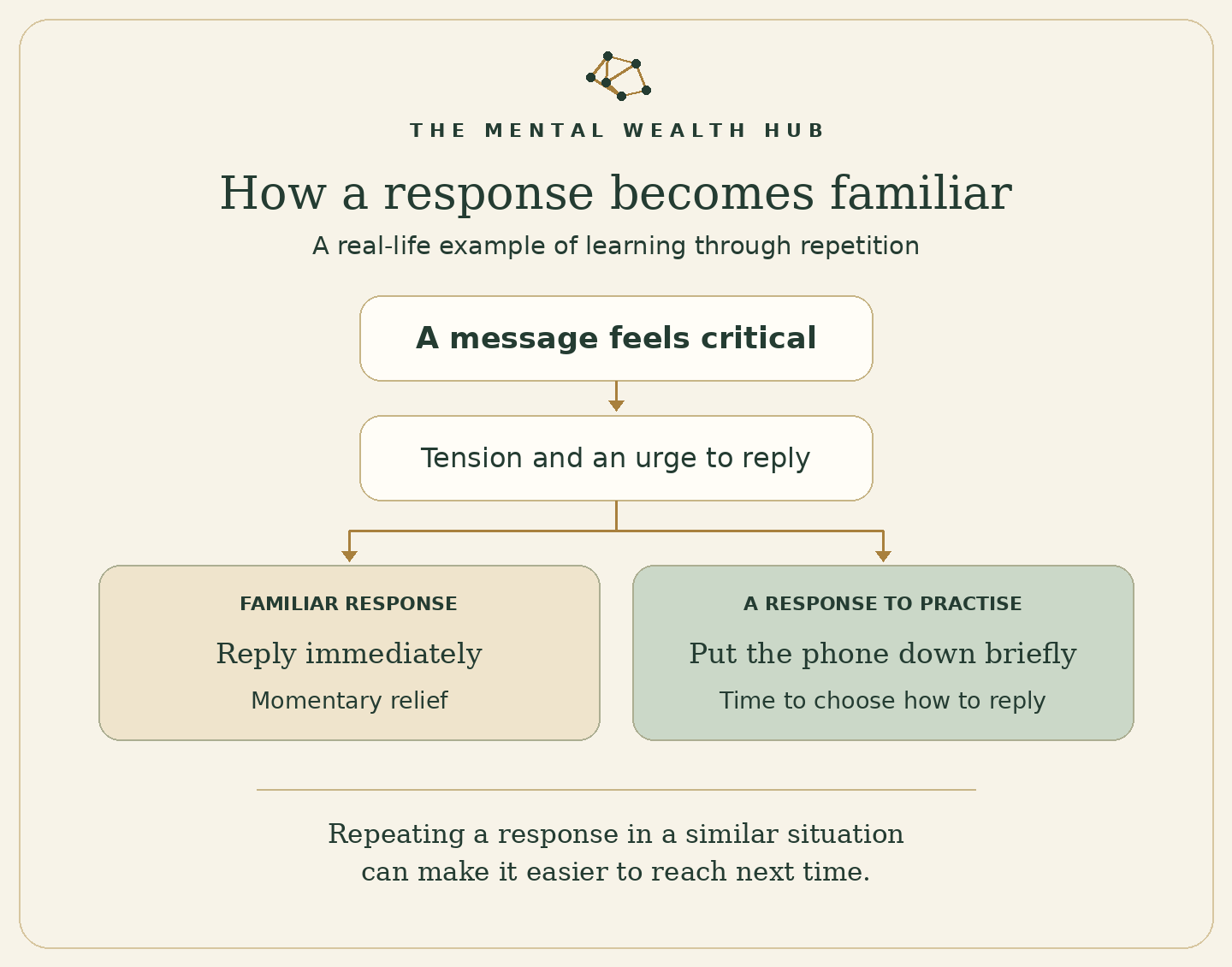
Imagine getting a message that feels critical. Your shoulders tighten and you reply immediately. Hitting send gives you a moment of relief, even if you regret it later. Now imagine noticing the tension and putting the phone down for a minute. You can still reply. You’ve given yourself time to decide how, with more space to respond thoughtfully
What about windows of change?
A therapy session, a change in your environment, or an psychedelic-assisted therapy experience can make a different choice feel possible. Use that opening to ask what you want to practise, where you’ll try it and who could support you when the old cues return. Coming back to the same routines can keep reinforcing the responses you already know.
Researchers are also investigating whether certain treatments change the brain’s readiness to learn. In one study, psychedelics reopened a specific window for social reward learning in mice. What that finding means for human learning and how long any comparable window might last are open questions. If you’re undertaking psychedelic-assisted therapy, integration can help you reflect on what came up and choose how to act on it with ongoing support.
We need to create space for change and become aware of the patterns that are there. Through therapy, psychedelics, coaching, and awareness of language and mindset, these things can change.
That window can be an exciting place to be, but the work can also be arduous, tiring and expensive. The investment can be deeply worthwhile when those habits and behaviours are no longer serving you. Change could become an extraordinary new beginning.
Explore Psychedelic-Assisted Therapies and Integration.
Start with one thing. Give yourself time.
Some of these habits, beliefs and behaviours may have been with you for decades. Your brain has had plenty of practice doing things this way, so give it time to learn another route. Pick one pattern and one response to practise. Start small, go slowly and get support when you need it.
“It won’t happen overnight, but it will happen.” An old shampoo ad had a point. Change has its own timeline, and some patterns take sustained work. Be kind to yourself when you slip back. Notice it, learn from it and keep trying.
Imagine what could become possible as you change the beliefs you live by, the habits you repeat and the choices you make. Those small moments of doing something differently can add up to a profoundly different life. Pretty extraordinary, really.
Founder's Insight
Realising that my brain could change was extraordinary. For forty-something years, I’d repeated ways of thinking, reacting and coping until they felt like part of who I was. Understanding that I could learn another way gave me hope, and a little more compassion for myself.
Through psychedelic-assisted therapy, I began recognising patterns I wanted to change. That led me towards neurofeedback, mindset coaching, vagus nerve stimulation and the everyday work of noticing my thoughts, language and behaviours. At times, it felt like teaching my brain from the beginning. I had decades of practice responding one way. Learning something different needed patience, repetition and support.
Old triggers and beliefs still surface. But now I can sometimes catch them, pause and ask, “Is this an old belief? An old response? Could I choose differently this time?” Having that moment of choice has been powerful.
I’m still a work in progress. Sometimes I have the energy to explore and practise. Other times, I need to rest, integrate and let things settle. I’ve needed people to help me navigate it all, encourage me and remind me to keep going.
Knowing I could change how I responded helped me imagine how different my life could become and that possibility is exciting.
Founder - The Mental Wealth Hub