
Bikram Yoga
The heat gets your attention. The postures ask you to focus. For some people, the quiet afterwards is what brings them back.
Bikram yoga can be demanding, absorbing and deeply personal. Each class offers a familiar structure in which to notice how you feel, how you respond to challenge and what changes when you give yourself time to be in your body.
What is it?
01Bikram is a structured form of hatha yoga, usually taught as a 90-minute class in a room heated to around 40–41°C with approximately 40% humidity. You will also see it called Original Hot Yoga or 26 & 2.
It is commonly described as 26 postures and two breathing exercises. Many familiar 26-step charts include the opening and closing breathing exercises in their numbering, grouping some movements together. The sequence below follows that familiar class order.
The class moves from standing work into floor postures, with periods of stillness along the way. Most movements are repeated. The consistency gives you something familiar to return to, even when you arrive feeling very different from the week before.
What may it help with?
02People are often drawn to Bikram for strength, balance, flexibility and the chance to switch off from everything outside the room. Holding a posture while listening to precise instructions can give a busy mind something immediate to concentrate on.
Some people describe leaving with a clearer head, a sense of achievement or a lighter mood. For others, it becomes a regular space for noticing feelings and reconnecting with their body.
How does it work?
03The sequence
The order creates a progression through balancing, stretching, backbending, forward folding and twisting. The standing section asks for concentration and steadiness. The floor section shifts the pace, bringing attention to the spine, hips, breathing and rest. Repeating the sequence lets you notice changes in your own practice over time.
The heat
The heated room is part of the traditional format. It adds a substantial physical challenge and makes temperature, sweat and breathing difficult to ignore. Some people enjoy the warmth and feel more comfortable moving in it. Keep your movement controlled, because feeling warmer does not mean you should stretch further.
The focus and mindset
You may wobble, lose your balance or feel frustrated. Each time you reset, you practise bringing your attention back to what you are doing. A steady gaze, the teacher’s instructions and your breathing can become anchors when your mind starts racing.
Patience matters. So does honest self-awareness. Bring a willingness to try, let go of comparing yourself with the person beside you and allow your effort to vary from day to day. Resting can be a thoughtful part of that discipline.
The clarity afterwards
After a demanding class, the contrast can feel striking. You have spent time moving, concentrating and being away from your phone and everyday demands. As you cool down and rest, you may notice a quieter mind or a feeling of spaciousness. Give yourself a few minutes to notice it before rushing back into the day.
What does the evidence say?
04A 2023 randomised trial found that adults with moderate-to-severe depression who attended heated hatha yoga had greater reductions in depressive symptoms over eight weeks than a waiting-list group. The study used Bikram-style classes, offering encouraging early evidence for mood support. [3]
What does a class look like?
05Expect a teacher guiding the room verbally through a familiar sequence, usually with mirrors to help you observe alignment. Bring a mat, a large towel and water. Arrive early, tell the teacher you are new and give yourself time afterwards to cool down.
The 26 steps
01 Standing Deep Breathing. A guided breathing exercise to begin the class and settle your attention.
02 Half Moon with Hands to Feet. Side bends, a standing backbend and a forward fold introduce movement through the torso.
03 Awkward Pose. A series of squat-like positions challenges the legs and balance.
04 Eagle Pose. Wrapping the arms and legs draws attention to coordination and steadiness.
05 Standing Head to Knee. A one-legged balance that progresses towards extending the lifted leg and folding forward.
06 Standing Bow Pulling. Holding one foot behind you while reaching forward combines balance with a backbend.
07 Balancing Stick. The body tips forward as the back leg lifts, asking for controlled balance.
08 Standing Separate Leg Stretching. A wide-legged forward fold brings attention to the backs of the legs.
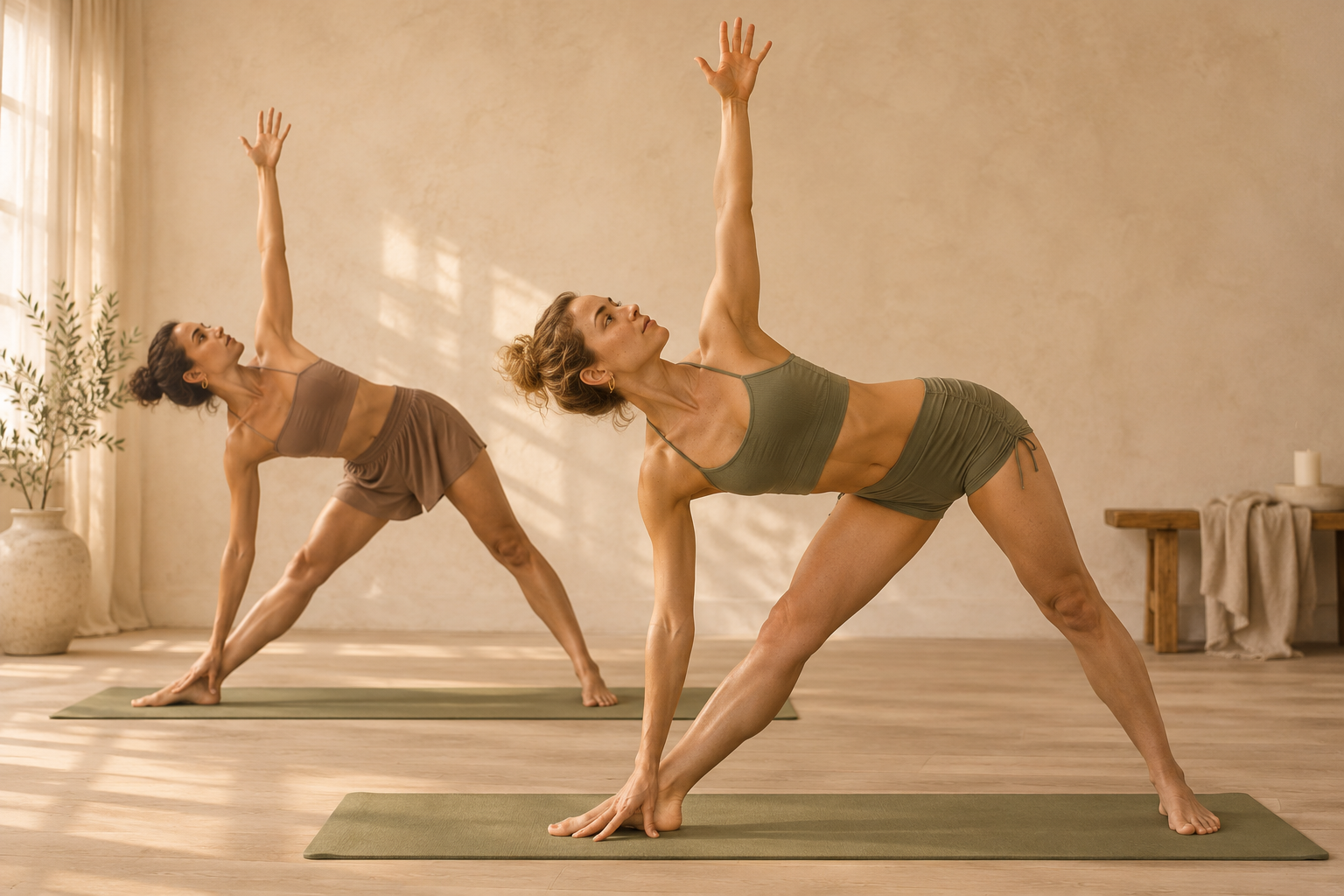
09 Triangle Pose. A wide stance, bent front knee and reaching arms challenge strength and coordination.
10 Standing Separate Leg Head to Knee. A staggered stance and rounded forward fold focus attention on alignment.
11 Tree Pose. Balancing on one leg with the other foot raised develops steadiness.
12 Toe Stand. A progression from standing balance towards a low balance, adapted to individual ability.
13 Savasana. Lying still on your back creates a pause between the standing and floor work.
14 Wind Removing Pose. Drawing one knee, then both knees towards the chest brings gentle movement to the hips and lower back.
15 Sit Up. A controlled transition from lying down to sitting, repeated between parts of the floor series.
16 Cobra Pose. A small prone backbend asks the back muscles to help lift the chest.
17 Locust Pose. Lifting the legs while lying face down develops awareness of the back of the body.
18 Full Locust Pose. The chest, arms and legs lift together in a broader back extension.
19 Bow Pose. Holding the ankles while lying face down creates a curved backbend.
20 Fixed Firm Pose. A kneeling posture that may progress towards reclining, according to knee and ankle comfort.
21 Half Tortoise Pose. A kneeling forward reach lengthens the body from hips to fingertips.
22 Camel Pose. A kneeling backbend opens the front of the body, with support adapted to your range.
23 Rabbit Pose. A rounded kneeling fold follows the backbend, with careful attention to the neck.
24 Head to Knee with Stretching Pose. Seated forward folds bring attention to the legs and controlled movement through the torso.
25 Spine Twisting Pose. A seated rotation invites a gradual, comfortable turn through the trunk.
26 Blowing in Firm. A seated breathing exercise closes the active sequence, followed by final rest.
These descriptions are a guide to the sequence. Let a qualified teacher show you the setup and appropriate variations.
Risks and considerations
06Heat deserves respect. Hydrate before and after class, and stop, cool down and tell the teacher if you feel dizzy, faint, nauseated or unwell. Avoid forcing a stretch or holding your breath to stay in a posture.
If you are pregnant, have a heart condition, are sensitive to heat or take medication that affects hydration or temperature regulation, check whether heated practice is suitable with a clinician who knows your circumstances.
After medicine work, return once acute effects have fully passed and your treating team has cleared you for heat and strenuous exercise. If emotions become overwhelming during class, pause and seek support. Tears can be meaningful without being a measure of how much healing has happened.
Questions to ask a teacher
07- Do you teach the traditional 90-minute sequence or an adapted class?
- How do you support beginners and people returning after time away?
- Can I rest, modify a posture or leave to cool down whenever I need?
- How do you support someone who becomes emotional during class?
Founder’s Insight
“It’s hot. It’s uncomfortable. Sometimes it’s a sad emotional release. But I can walk out feeling elated, free and so much lighter.”
Bikram has been a powerful part of my healing, especially after medicine or trauma work. It gives me space to feel what’s happening in my body and move through it.
Getting through the door can take some convincing. It’s hot, it smells, and some days I’d happily find an excuse. But once I’m there, the concentration brings me into the present. For me, it’s a 90-minute meditation. In those last five poses, something can shift. I’ve found myself literally sobbing in class at times after loss. It feels like emotions I’ve been holding finally have room to move. Uncomfortable, yes, but incredibly freeing.
The clarity afterwards can be extraordinary. I leave feeling lighter, more connected to myself and grateful I showed up. Bikram reminds me that I can meet discomfort with patience and care, and discover something powerful on the other side.
Founder, The Mental Wealth Hub
You’ve read about it. Now what can you actually do?
You don’t need to have the perfect plan. Choose the next step that feels most useful for where you are right now.
Always speak with a qualified health professional before starting something new. If you are struggling right now, find immediate support.
Want to keep exploring?
Recommended articles, books, podcasts and lived experiences related to this topic.
Explore the LibraryRelated Tools
This is educational information. It is not a recommendation that this approach is right for you. Always speak with a qualified health professional.
