
Kinesiology
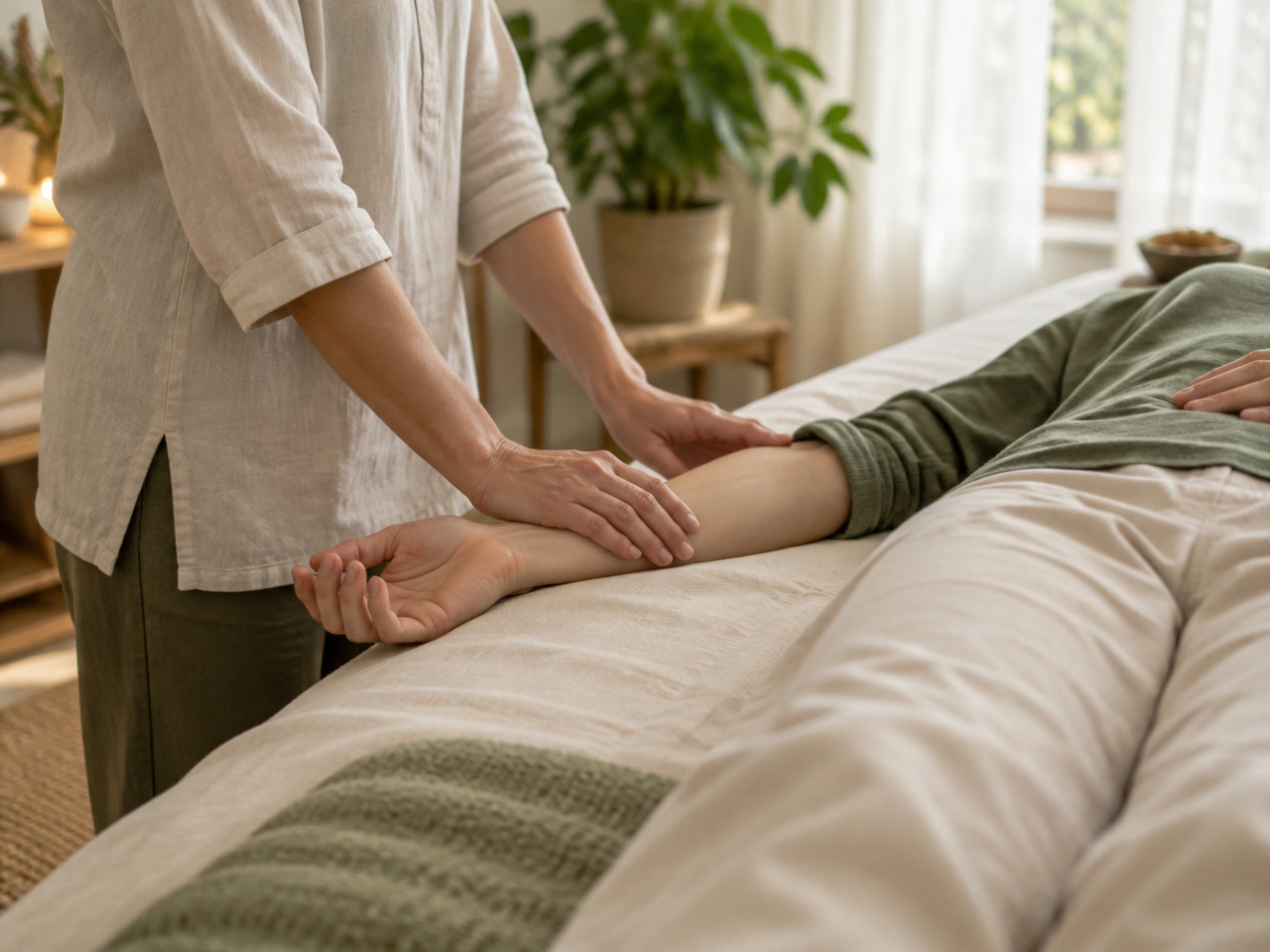
You sit or lie comfortably, fully clothed. The practitioner might ask you to hold out an arm, then apply gentle pressure while you focus on something that’s been weighing on you.
Sometimes your arm holds firm. Sometimes it gives a little. The practitioner interprets these changes as a starting point for exploring what you’re experiencing.
What is it?
01Kinesiology can refer to the academic study of human movement. Here, we’re exploring energy kinesiology and applied kinesiology, wellness practices centred on muscle testing.
These approaches grew from chiropractic practice in the 1960s. Related methods include Touch for Health, Professional Kinesiology Practice and Neuro Emotional Technique, or NET.
During a session, the practitioner uses muscle responses to guide their approach while you focus on an issue, memory or feeling. They may combine this with acupressure points, light touch, breathing or conversation.
What may it help with?
02People often explore kinesiology when stress has been building, familiar patterns keep repeating or something from the past still feels unresolved.
The appeal can be having space to notice feelings and make personal connections without explaining every detail. Some people describe feeling lighter or experiencing an emotional release afterwards.
How does it work?
03Kinesiologists see muscle testing as a way of listening to the body. The idea is that stress, and the emotions linked to it, can show up as subtle changes in how a muscle responds. The practice draws on chiropractic and on the meridian map used in acupuncture.
A session also brings together several things that many people find settling: gentle, caring touch, slowing down to notice your body, and turning towards something difficult while feeling supported.
Many kinesiologists also use acupressure points, the same points used in EFT tapping. You’ll find more on tapping in Therapies + Psychology.
What does the evidence say?
04Kinesiology is still lightly studied, and the research so far answers two different questions.
Can sessions help with emotional distress? The early research is encouraging. In a small study in the US, people living with distressing memories after cancer were randomly assigned to sessions of the Neuro Emotional Technique, one branch of kinesiology, or to a waitlist. Those who had the sessions reported less distress, anxiety and traumatic stress, and brain scans showed calmer reactions when they heard their distressing memory described [1]. This research was funded by a foundation closely connected with the Neuro Emotional Technique.
In a 2022 study, clients of Touch for Health based kinesiology described greater self-awareness, a stronger sense of wellbeing and more motivation to look after themselves [2].
Can muscle testing diagnose health problems? Here the research is clearer. When muscle testing has been studied as a way to detect things like nutrient levels, it hasn’t given reliable results [3]. So it’s best used as a way of exploring, not diagnosing.
For a practice so many people value, it deserves more research.
What does a session or practice look like?
05A first session usually begins with a conversation about your health, your history and what brought you in. Then you lie on a treatment table, fully clothed.
The practitioner will test different muscles many times during the session, usually your arm or leg, using light pressure while you hold it in place. You might be asked to think about a particular situation, say a phrase or recall a memory. Depending on what comes up, they may hold or tap points on your head and body, guide your breathing or talk things through with you.
Sessions usually last about an hour, and a course of several is common. Kinesiology isn’t covered by private health insurance, so sessions are an out-of-pocket cost.
Risks and considerations
06Use it for exploring, not diagnosing. Muscle testing hasn’t proven reliable for diagnosing illness or allergies, or for deciding on medication, supplements or foods to cut out. If a practitioner suggests these based on muscle testing, check with a health professional before acting on it.
Ask about training. Kinesiologists aren’t registered with AHPRA, and anyone can use the title. Training varies widely.
Questions to ask a practitioner
07- What have you trained in, and which professional association do you belong to?
- What will you use muscle testing for, and what won’t you use it for?
- Do you give advice about supplements, food or medication?
- Is your approach trauma-informed, and what happens if something difficult comes up?
Founder’s Insight
“Every time I go, it feels like my body brings something up that my mind hadn’t even considered.”
I stumbled across kinesiology in my twenties and have found it incredibly helpful. Often, something surfaces that I had no idea I was still holding onto. An old memory, a feeling, a connection I would never have reached by thinking it through.
It can take me back years ago to where a pattern may have started. When those connections come up, they often make sense to me, and exploring them can bring a real sense of release.
I often combine kinesiology with NET and acupuncture through my chiropractor. It’s become a valuable way for me to notice what I’m feeling, release it and explore things I might otherwise overlook.
Founder, The Mental Wealth Hub
You’ve read about it. Now what can you actually do?
You don’t need to have the perfect plan. Choose the next step that feels most useful for where you are right now.
Always speak with a qualified health professional before starting something new. If you are struggling right now, find immediate support.
Want to keep exploring?
Recommended articles, books, podcasts and lived experiences related to this topic.
Explore the LibraryRelated Tools
This is educational information. It is not a recommendation that this approach is right for you. Always speak with a qualified health professional.
