
EFT tapping
You can sometimes shift how you feel in a few minutes with just your mind and your hands. Gently tap a few points on your body, reframe what you're feeling and see if the intensity eases. A small shift can be enough to help you think a little more clearly or get on with the next thing.
It sounds a little strange. But for many people, tapping has become one of the quickest ways to find their way back to calm, and it's attracting a growing body of research, much of it here in Australia.
What is it?
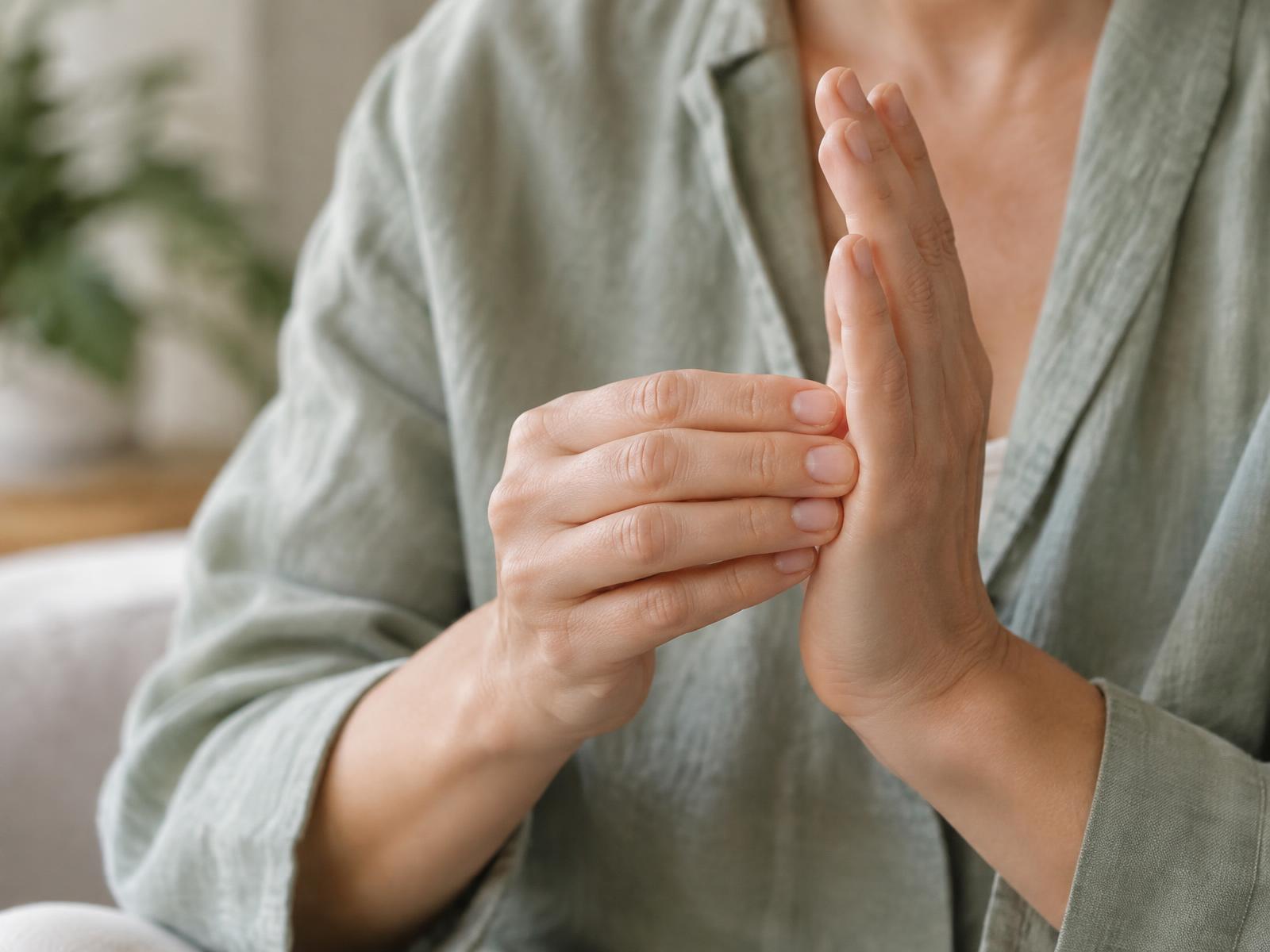
01Emotional Freedom Techniques, or EFT, is often simply called tapping. You tap lightly with your fingertips on a series of points on your face, hands and upper body, while naming what's bothering you and how strongly you feel it.
It was developed in the United States in the 1990s by Gary Craig. It draws on points used in acupressure, and combines them with two things used in conventional therapy: turning towards what distresses you rather than avoiding it, and offering yourself acceptance alongside it.
You can learn the basics in a few minutes and use it on your own, for free. It's also offered as a structured therapy, usually called Clinical EFT, by trained practitioners and psychologists.
Tapping on your face while talking to yourself can feel a little odd at first. That's normal. Most people find the self-consciousness passes once they notice something shift.
What may it help with?
02People often turn to tapping when stress or anxiety rises quickly and they want something practical they can do straight away.
Why does my body react before my mind has caught up? Why can't I calm down, even when I know I'm safe? Why do the same cravings and habits keep pulling me back?
EFT is commonly explored for anxiety, stress, trauma symptoms, food cravings and pain.
Tags: Anxiety · Stress · Trauma symptoms · Food cravings · Chronic pain
How does it work?
03- Naming it. You bring the difficult feeling, memory or craving to mind, and say it out loud. Rather than pushing it away, you turn towards it.
- Accepting yourself alongside it. You pair what you're feeling with a statement of acceptance, such as "Even though I feel this anxiety, I accept myself as I am now."
- Tapping. You tap on a sequence of points while repeating a short reminder phrase. The rhythm is soothing, and it gives your body somewhere to put its attention.
Many people describe feeling the intensity ease as they tap. Sometimes it drops quickly. Sometimes another layer of the feeling comes up, and you tap on that too.
It isn't about pretending everything is fine. It's about letting yourself feel what's there, while giving your body a sense of calm at the same time.
"EFT is simply a stress reduction technique. We focus the mind on what we are feeling and tap on known acupuncture points to give the brain and body a sense of calm."
Professor Peta Stapleton, Bond University, 2024
What does the evidence say?
04EFT has a larger body of research than many people expect, and Australia has helped lead the way. Professor Peta Stapleton, a clinical psychologist at Bond University on the Gold Coast, is one of the world's leading EFT researchers, and her team has carried out many of the key trials. She has described her early results as showing that "this weird tapping thing actually worked".
An Australian trial compared EFT directly with CBT for food cravings in adults living with overweight or obesity. Both worked about as well as each other, and the benefits held a year later. Comparing EFT with an established therapy, rather than a waiting list, makes this a meaningful result. [1]
For PTSD, a 2023 review found large benefits compared with waiting lists or usual care, and results similar to other evidence-based therapies when compared with them directly. [2] An independent 2025 review by a team of psychiatrists in Taiwan also found EFT reduced PTSD symptoms, along with anxiety and depression, with benefits lasting up to three months. [4]
Stress has been studied closely. A 2026 review of 17 trials found Clinical EFT led to large reductions in how stressed people felt, and more modest changes in stress measured in the body. [3]
Much of the EFT research comes from researchers who also practise and teach the method. That's common in therapy research, and it's one reason independent reviews such as the 2025 review matter.
None of this means EFT suits everyone.
What does a session or practice look like?
05On your own, a round of tapping takes a few minutes. With a practitioner, sessions usually run for about an hour, and the work can go deeper, often towards specific memories or patterns.
EFT can be done one-on-one, in groups, online, or on your own with guided videos and apps.
Try a guided round of tapping
1. Name what you're feeling. Pick one thing you can notice right now, like "My chest feels tight when I think about tomorrow." Give the feeling a number from 0 to 10 so you can check whether it shifts.
2. Start at the side of your hand. With two fingertips, gently tap the fleshy outer edge of your other hand, below the little finger. Keep tapping as you say your opening phrase three times, out loud or in your head. Try "Even though I feel anxious right now, I can give myself a moment to settle."
3. Tap through the eight points. Use light taps, about five to seven at each spot. You can use either side of your face or body. On this first round, stay with what you actually feel. You can repeat the same words at each point, like "this tightness in my chest" or "all this worry about tomorrow."
| Tapping point | Where to tap |
|---|---|
| Tapping point1Inner eyebrow | Where to tapWhere your eyebrow begins, close to the bridge of your nose. |
| Tapping point2Side of the eye | Where to tapOn the bone just outside the outer corner of your eye. |
| Tapping point3Under the eye | Where to tapOn the cheekbone directly below your eye. |
| Tapping point4Under the nose | Where to tapBetween your nose and upper lip. |
| Tapping point5Chin point | Where to tapIn the crease between your lower lip and chin. |
| Tapping point6Upper chest | Where to tapFrom the little hollow at the base of your throat, move about 2–3 cm down and 2–3 cm to either side, just below the collarbone. |
| Tapping point7Under the arm | Where to tapOn the side of your ribs, about a hand's width below your armpit. |
| Tapping point8Top of the head | Where to tapOn the crown of your head. |
4. Pause, then try a calmer phrase. Take an easy breath and check your number again. If the feeling is still strong, you can do another round using words that match it. If you feel a little more settled, go through the same points with a phrase that feels true. Try "I'm safe right now," "I'm feeling a little calmer," or "I can take this one step at a time." If "I'm calm" feels like too big a leap, try "I can give myself a minute."
If your child wants to join in, you can tap alongside them and keep the words simple. Let them use their own words, or just follow along with the tapping.
Guided tapping apps
A guided session is handy when you're already overwhelmed and want someone to talk you through where to tap and what to say.
- The Tapping Solution offers guided sessions for stress, anxiety and sleep, plus short tap-along videos for kids. Explore The Tapping Solution
- Eftly is an iPhone option with voice guidance and an animation that shows where to tap. View Eftly on the App Store
Finding the right person
EFT training matters. So does how you feel in the room. If you're working with trauma, look for someone who is trauma-informed and knows how to slow things down. You're allowed to look elsewhere if the fit isn't right.
Going further
- The Science Behind Tapping by Professor Peta Stapleton brings together the research and a beginner's guide to tapping.
- Brad Yates is known for his warm, often humorous approach to tapping, and has more than 1,200 tapping videos on YouTube.
- Nick Ortner's book The Tapping Solution, and The Tapping Solution app, offer guided tapping for many different feelings and situations.
Questions to ask a practitioner
06- What EFT training have you completed, and are you also a registered psychologist or a member of a professional body?
- How much experience do you have supporting people with what I'm going through?
- Is your approach trauma-informed, and what do you do if something difficult comes up?
- Will you teach me to use tapping on my own between sessions?
- How will we know whether it's helping?
Founder’s Insight
"Tapping has taken the edge off anxiety for me and my kids. Sometimes a little relief is exactly what we need."
What I like about tapping is that it gives me something to do with my body when my mind is going a hundred miles an hour. I can start with "I feel really anxious right now" and, if it feels right, move towards "I can take this one step at a time." That second sentence has to feel believable. Otherwise I'm just repeating words.
For me, that's where tapping fits into the rewire work. It's a chance to notice how I'm talking to myself and practise a response I can actually get behind. I had an app at some point, which when I used it, it could definitely calm my nervous system and my state in that time and space. Getting used to it was a little tricky because it felt odd at first. I think watching my youngest calm while I was tapping him made me realise the true impact of what it can do, and maybe that was the human touch or the reframing of the thought. But there's something to it.
Founder, The Mental Wealth Hub
You’ve read about it. Now what can you actually do?
You don’t need to have the perfect plan. Choose the next step that feels most useful for where you are right now.
Always speak with a qualified health professional before starting something new. If you are struggling right now, find immediate support.
Want to keep exploring?
Recommended articles, books, podcasts and lived experiences related to this topic.
Explore the LibraryRelated Tools
This is educational information. It is not a recommendation that this approach is right for you. Always speak with a qualified health professional.
