
I've spent decades working alongside people living with extreme poverty, discrimination and seemingly impossible odds. I've sat with women in villages in Bangladesh, India and across Africa who were married as children, denied an education and spent their lives being told what they could and couldn't do. I've watched women find the courage to speak in public for the first time, challenge decisions made by powerful men and organise with others to change the conditions their families were living in.
These experiences have taught me something profound about being human. We have far more capacity for change than we often realise.
And sometimes, one of the biggest obstacles is what we've come to believe about ourselves.
This is what I mean by mindset: the beliefs and stories we carry about ourselves, other people and what's possible for us. They shape how we see the world, the choices we make and what we believe we're capable of. Some open up possibilities. Others can keep us stuck, sometimes for years.
A limiting mindset might sound something like this:
I'm not good enough. I always mess things up. Nobody really cares about me. Things will never get better.
When we're struggling with our mental health, these stories can become particularly loud and convincing. We may have been telling ourselves the same things for so long that they feel like facts.
But what if the story you're telling yourself isn't true?
But what if the story you're telling yourself isn't true? It might feel true. You might even have plenty of evidence to support it. But when we believe something for long enough, we start seeing everything through that lens. We notice what confirms our belief and overlook what challenges it. Eventually, we stop recognising it as our interpretation and simply assume it's the truth.
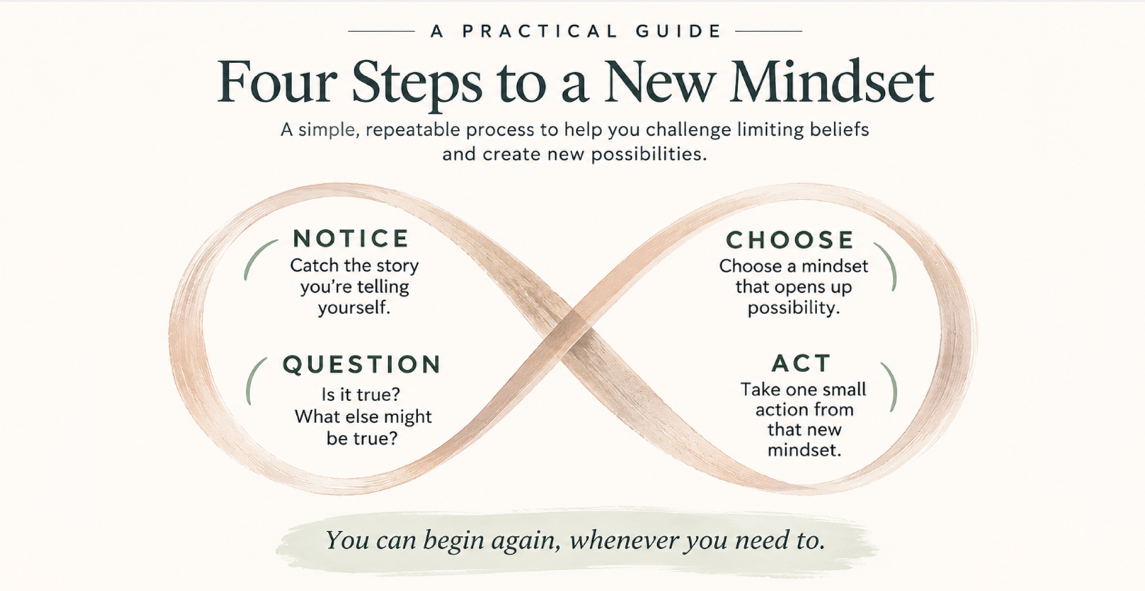
Drawing on decades of working with people in villages and communities, and with leaders and teams around the world, I've developed a simple four-step process to help people recognise the beliefs that may be keeping them stuck and begin to create new possibilities.
Here's how The Mindset Process works.
Say you've been having a difficult time. You've withdrawn from friends, stopped returning messages and turned down invitations. You're lonely and would love to reconnect, but something stops you.
1. Notice
Start by catching the story you're telling yourself.
I'd love to get in touch with my friends, but I've been such a terrible friend. They probably don't want to hear from me.
There it is. You've identified a belief that may be getting in your way. That's all you need to do for now. Notice the mindset, aka the story you're telling yourself.
2. Question
Now get curious about that belief.
Is it true that I'm a terrible friend?
Maybe yes. Maybe no. Maybe sometimes. All answers are okay. You're exploring a belief you've been treating as the truth.
What else might be true? How else could I think about myself and this situation?
You might realise that you've been going through a difficult time and haven't had much energy for friendships. That you've been a caring and generous friend in the past. Or that your friends may have missed you and would be delighted to hear from you.
The important thing is to start seeing other possibilities, rather than automatically accepting the story you've been telling yourself.
3. Choose
Now choose a new mindset. One that gives you more freedom to be the person you want to be.
It might be I'm a good friend who values connection. Or I'm someone who reaches out to people I care about, even when life is hard.
You might choose something bolder: I'm worthy of love and friendship, exactly as I am.
Your new mindset will feel strange or even untrue at first. That's okay. You've spent years reinforcing old beliefs, and you're now practising a different way of seeing yourself. With repetition and action, you're helping your brain build new pathways.
Choose a mindset that opens up possibility for you. Say it to yourself. Imagine how you would feel, what you would do and how you would approach your relationships if you started living from this new mindset.
Even the tiniest action counts.
4. Act
Ask yourself: What's one thing someone with this new mindset would do?
Perhaps send a message to a friend. Or find a photo of a happy time together and remember what you love about your friendship. You might simply open your messages and decide who you'd like to respond to or connect with.
Even the tiniest action counts.
Each time you act from your new mindset, you're practising it and helping it become more familiar.
And when that old story returns, as it will, you can begin again. Notice. Question. Choose. Act.
My voice matters. I have something valuable to contribute.
I've witnessed the extraordinary changes that can begin with a shift in mindset.
I've worked with women in rural villages who grew up believing that decisions belonged to men and that their voices didn't matter.
A woman in this situation might begin to notice that whenever she wants to speak at a village meeting, a familiar thought stops her: Who am I to say anything? I'm just an uneducated woman.
She starts to question that belief. Is it true that I have nothing worth saying? Don't I know what my family and community need?
She chooses a new mindset: My voice matters. I have something valuable to contribute.
And then she acts. Perhaps the first time, she simply raises her hand. The next time, she speaks. Eventually, she may be the woman organising others, challenging injustice and helping her village create a different future.
I've witnessed countless transformations like this - people discovering that what they've always believed about themselves may no longer be the story they want to live by.
Of course, mental health struggles are real and complex. Changing our mindset isn't a substitute for professional care, medication or the support we may need. And some circumstances are genuinely beyond our control.
But even when we can't change everything around us, there is always something we can change in how we see ourselves and what we believe is possible.
You don't have to transform your whole life today.
Perhaps you can begin by noticing one story you've been telling yourself.
And asking: What else might be possible?
About Cathy Burke
Cathy Burke has spent much of her life exploring what becomes possible when people begin to see themselves differently. For 25 years she was a global leader at The Hunger Project, working alongside women and communities across Africa and South Asia who were transforming their lives against extraordinary odds. Those experiences profoundly shaped her understanding of courage, mindset and our capacity to create change.
Today, Cathy brings those insights to her work with leaders and people from all walks of life. She is the author of three books, Unlikely Leaders, Lead In and Today I Saw a Revolution, each exploring, in different ways, the extraordinary potential of ordinary people.
