
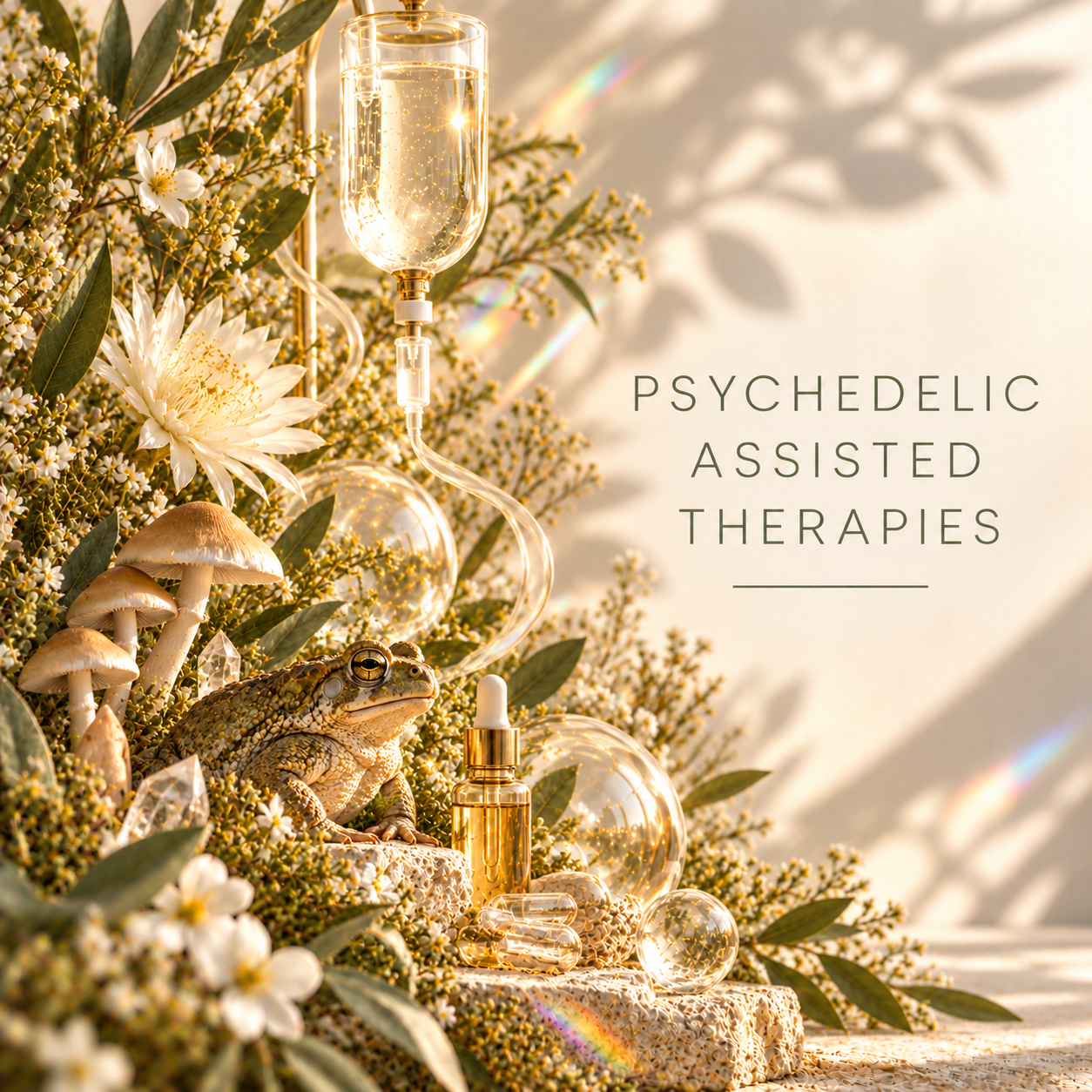
For thousands of years, Indigenous cultures have worked with plant medicines in ceremonial and healing traditions. Today, substances such as psilocybin, MDMA, ketamine and ibogaine are being studied through the lens of modern medicine, neuroscience and psychotherapy. In Australia, tightly regulated access already exists for authorised psychiatrists to use MDMA for PTSD and psilocybin for treatment-resistant depression [1], while research continues into a much broader range of applications. For me, this is one of the most exciting developments happening in mental health.
I say that not only because I have followed the research, but because psychedelic and plant medicine work has played an enormous role in changing my own life. It has helped me access parts of myself that years of talking, thinking, analysing and trying to “fix” myself could never quite reach. It helped me understand trauma differently. It showed me patterns I had carried for decades, helped me process grief and pain that had been buried, and gave me a completely different relationship with addiction, myself and my own mind. But I also want to be very clear about something.
Psychedelics are not for everyone. And they are not something I believe should be treated casually. The word “psychedelic” has become fashionable again, and that concerns me almost as much as it excites me. These can be incredibly powerful medicines, and powerful medicines deserve respect.
Proper medical and psychological screening matters. Personal and family psychiatric history matters. Medications matter. Physical health matters. The medicine itself matters. The dose matters. And for people with certain psychiatric vulnerabilities, including psychotic disorders, the risks need to be taken extremely seriously. People with schizophrenia, for example, are generally excluded from psychedelic clinical trials because of concerns about triggering or worsening psychosis [5].
The medicine is only one part of the process
This is exactly why psychedelic-assisted therapy should never simply mean “taking a psychedelic.” The medicine is only one part of the process. It can open the door, but what you do after that can make all the difference. What happens before and during the experience matters. Preparation, safety, setting and the right support are incredibly important. But what happens afterwards is often where the real change begins.
Integration is where insight becomes action. It is where you take what you saw, felt or understood and begin applying it to your relationships, behaviours, choices and everyday life. The medicine may show you the door.
What you do after you walk through it can change your life.
That distinction matters enormously to me. A profound psychedelic experience can show you something. It can crack something open. It can create a window where you see yourself and your life from a completely different perspective. But you still have to do the work. You still have to change the relationship, behaviour, environment or belief that is hurting you. You still have to regulate your nervous system. You still have to look after your body. You still have to build connection, boundaries, meaning and healthier patterns. The medicine cannot live your life for you. And that, to me, is where some of the hype around psychedelics gets it wrong.
Not another magic pill
Much of conventional mental healthcare has understandably focused on reducing symptoms. Pharmaceuticals absolutely have a place in that system, and for many people they can be lifesaving, stabilising and essential. I do not believe the conversation should be about demonising medication or pretending psychedelics will replace psychiatry. I think the more interesting question is: what else is possible?
What if, alongside managing symptoms, we became better at understanding what sits underneath them? What happened to this person? What does their nervous system need? What beliefs have they carried since childhood? What are they suppressing? What are they grieving? What environment are they living in? What support do they have? What is happening with sleep, nutrition, hormones, relationships, trauma and purpose?
For some people, psychedelic-assisted therapy may help them explore those questions in a completely different way. And that is why I think this field has so much potential.
What are we actually talking about?
“Psychedelic therapy” is not one medicine or one experience. Psilocybin, the psychoactive compound found in certain mushrooms, is being investigated particularly heavily for depression and other mental health conditions [3]. MDMA is technically an empathogen rather than a classic psychedelic, but in therapy it may help some people engage with traumatic memories with less fear and defensiveness [2].
Australia currently allows tightly controlled access to MDMA for PTSD and psilocybin for treatment-resistant depression through authorised psychiatrists, although both remain unapproved therapeutic goods rather than routine medicines [1]. Ketamine works differently again and already has established medical uses, while ketamine-assisted psychotherapy has become another developing area of mental healthcare.
Then there is iboga and its active compound ibogaine, which have attracted enormous interest particularly in addiction treatment. There is 5-MeO-DMT, an extraordinarily powerful and short-acting psychedelic. And there are longstanding ceremonial medicines such as ayahuasca, which sit within cultures and traditions far older than modern psychedelic medicine.
These substances should not be thrown into one bucket. They have different pharmacology, different risks, different durations and very different therapeutic contexts. The Hub will explore them individually. Not to tell people what to take. But to help people understand what they are, what the evidence currently says, what the risks are, where research is heading and what questions people should be asking before considering any form of psychedelic-assisted therapy.
Beyond the psychedelic experience
One area receiving enormous attention is microdosing: taking very small, usually sub-perceptual doses of a psychedelic substance. There are compelling personal accounts, and there are interesting areas of emerging research. But this is also a perfect example of why the Hub needs to separate excitement from evidence. At this stage, controlled research has not established microdosing as a replacement for antidepressants. The evidence remains mixed and still developing, with some reported benefits not consistently reproduced in placebo-controlled trials [4]. That does not mean the field should be dismissed. It means we stay curious. We research it properly.
And we do not turn possibility into certainty before the science gets there.
The real renaissance
Perhaps that is what excites me most about this moment. The psychedelic renaissance is not simply about bringing old medicines back. It represents a bigger shift in how we think about healing. Away from asking only, “How do we stop this symptom?” And toward asking, “What is happening underneath it?” It creates space for neuroscience and ancient wisdom to sit in the same conversation. For medicine and psychotherapy to work together. For trauma, the body and the nervous system to become part of mental healthcare rather than afterthoughts.
And critically, it forces us to recognise that a person’s vulnerability during these experiences demands extremely high standards of care. For me, that is where this movement needs to go. Not toward handing out psychedelics. Toward building better containers for transformation. Better screening. Better preparation. Better therapists. Better medical oversight. Better integration. Better research. And far greater respect for both the power of these medicines and the people receiving them.
I have experienced what some of these medicines can open up in a human being, and they have changed my life in ways I am still understanding. But I do not believe the medicine did the healing for me. It showed me things I could no longer unsee. It gave me access to parts of myself I had struggled to reach. But the healing came from what I chose to do with that afterwards. That is why I believe we are standing at the beginning of something incredibly important. Not a cure-all. Not a shortcut. Not another wellness trend.
A new chapter in mental health, built partly from some of humanity’s oldest tools and now being examined through modern science. And if we approach it with the intelligence, humility, safety and respect it deserves, I believe it could completely change what we understand healing to be.
Carlie Silva
Founder, The Mental Wealth Hub